
This post may contain affiliate links. For more information, see our privacy policy.
This Potato Focaccia, aka Focaccia Pugliese, is a beloved bread from the sunny heel of Italy with fluffy interior, large artisan air holes and a crisp, golden crust. Normally an overnight affair, this recipe uses a few secret tricks so it can be made in an afternoon with minimal hands-on time!
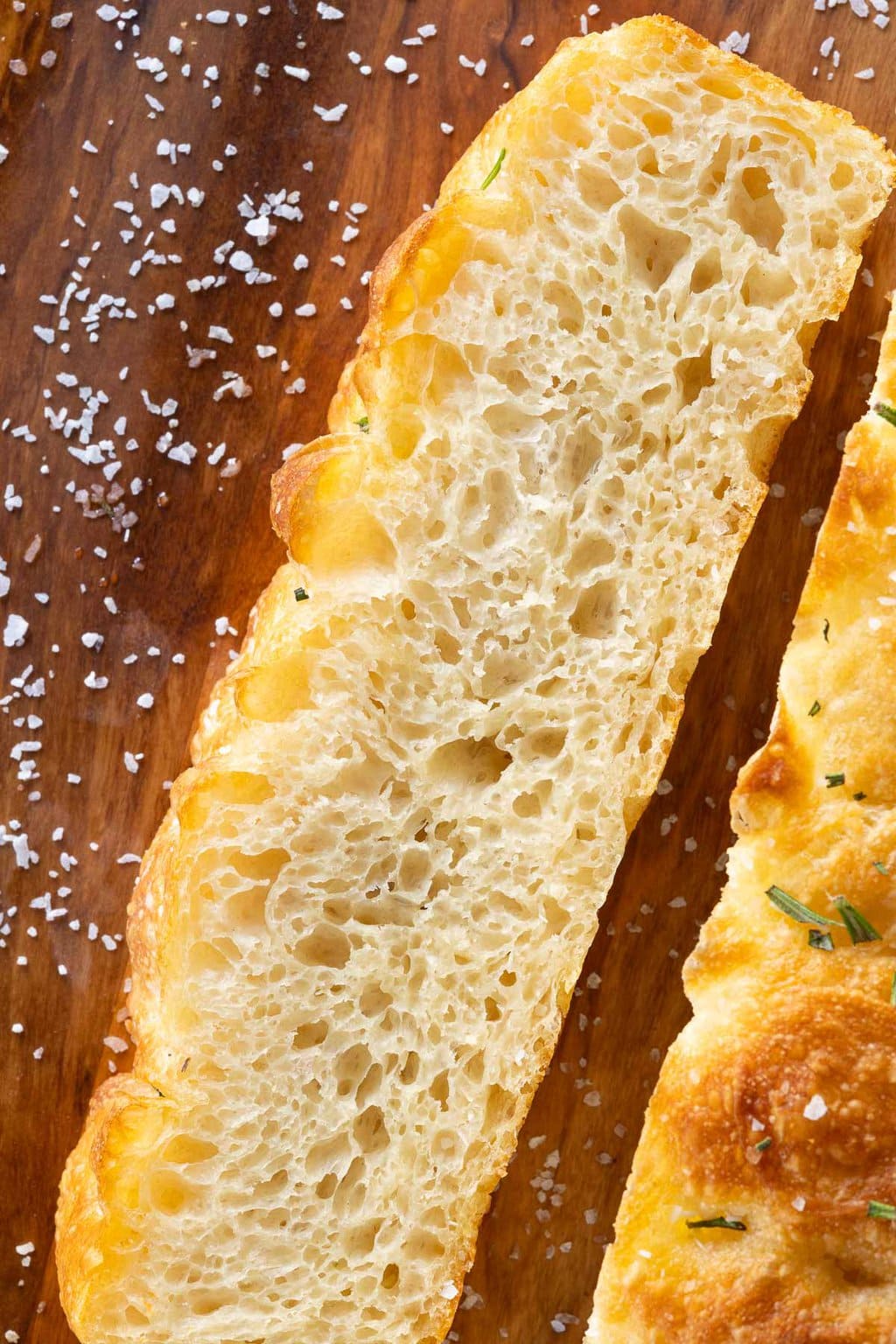
I would be remiss if I didn't warn you from the get-go that this Potato Focaccia is dangerous! Although we have seven other delicious focaccia recipes in The Café archives, this southern Italian version just might win "the favorite" contest in our book! With a soft, pillowy interior, lots of bubbly artisan airholes and an impossibly crisp exterior, everyone who tries this beautiful bread is smitten!
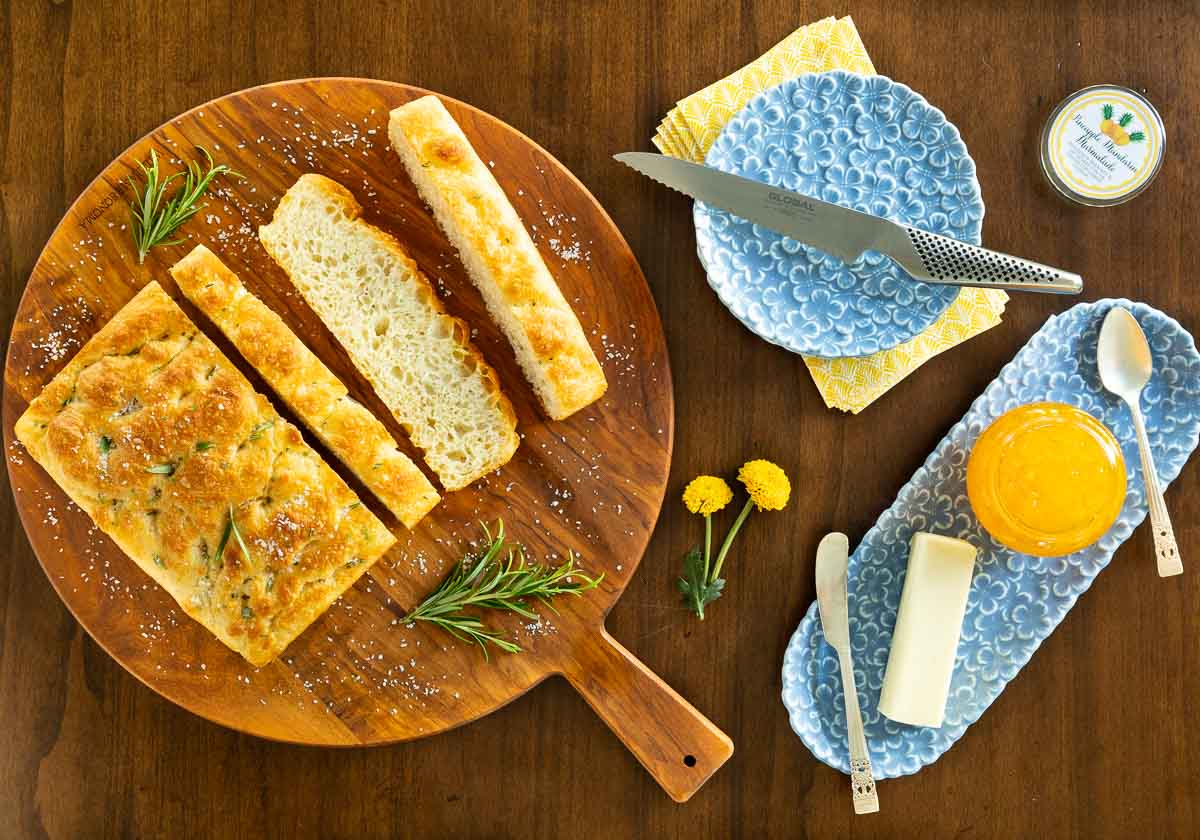
I was intrigued last summer when I read about Focaccia Pugliese (pronounced like this). The descriptions called it "incredibly light and fluffy", "with a soft pillowy interior" and "a crisp olive oil rich crust". What's not to like about all that?
It's called "Pugliese" focaccia because it originated (and is still super popular) in Puglia, a region of Italy that stretches down the southeast coast. The secret ingredient in Focaccia Pugliese is potato!
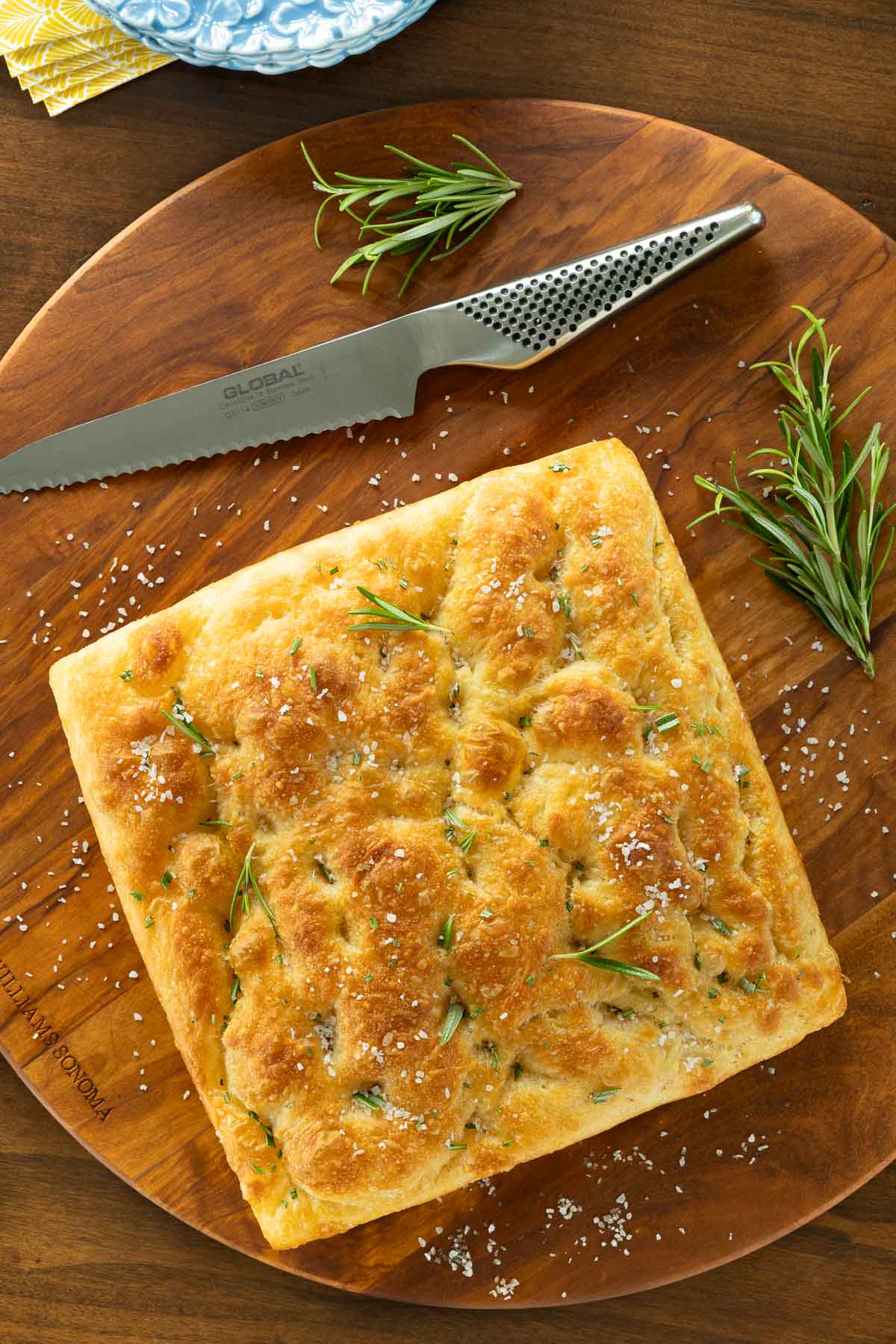
Potatoes?
If you've tried our Easy No-Knead Potato Rolls recipe, you understand the magic of potatoes in bread recipes. In the old days, bakers just knew that adding potatoes or potato water to their bread dough created delicious results. These days, we have science to back things up. Here's how Southern Living Magazine explains the science of potato starches and how they work their magic:
- Potatoes are rich in potassium which causes yeast to rise faster than it would with dough that contains only wheat starch.
- Potato starches attract and hold more water than wheat starches which helps to increase the moisture content in baked goods. They also make yeast dough easier to shape and handle.
- Potatoes help create a soft, tender crumb. When potatoes are boiled, the starch molecules enlarge, making it difficult for the proteins in the flour to form gluten. Too much gluten is the nemesis of light, airy breads and pastries.
- Lastly, potatoes help create a longer shelf life for bread. As baked bread cools, starches begin to crystallize and trap water inside the crystals, causing the bread to harden and dry out. When bread contains potatoes, however, the potato starch molecules make it harder for the wheat starches to crystallize, keeping the bread fresh and soft longer.
That's why everyone who tries this Potato Focaccia remarks on how fluffy and tender it is! I love that it also has a crisp, golden crust. A win-win!
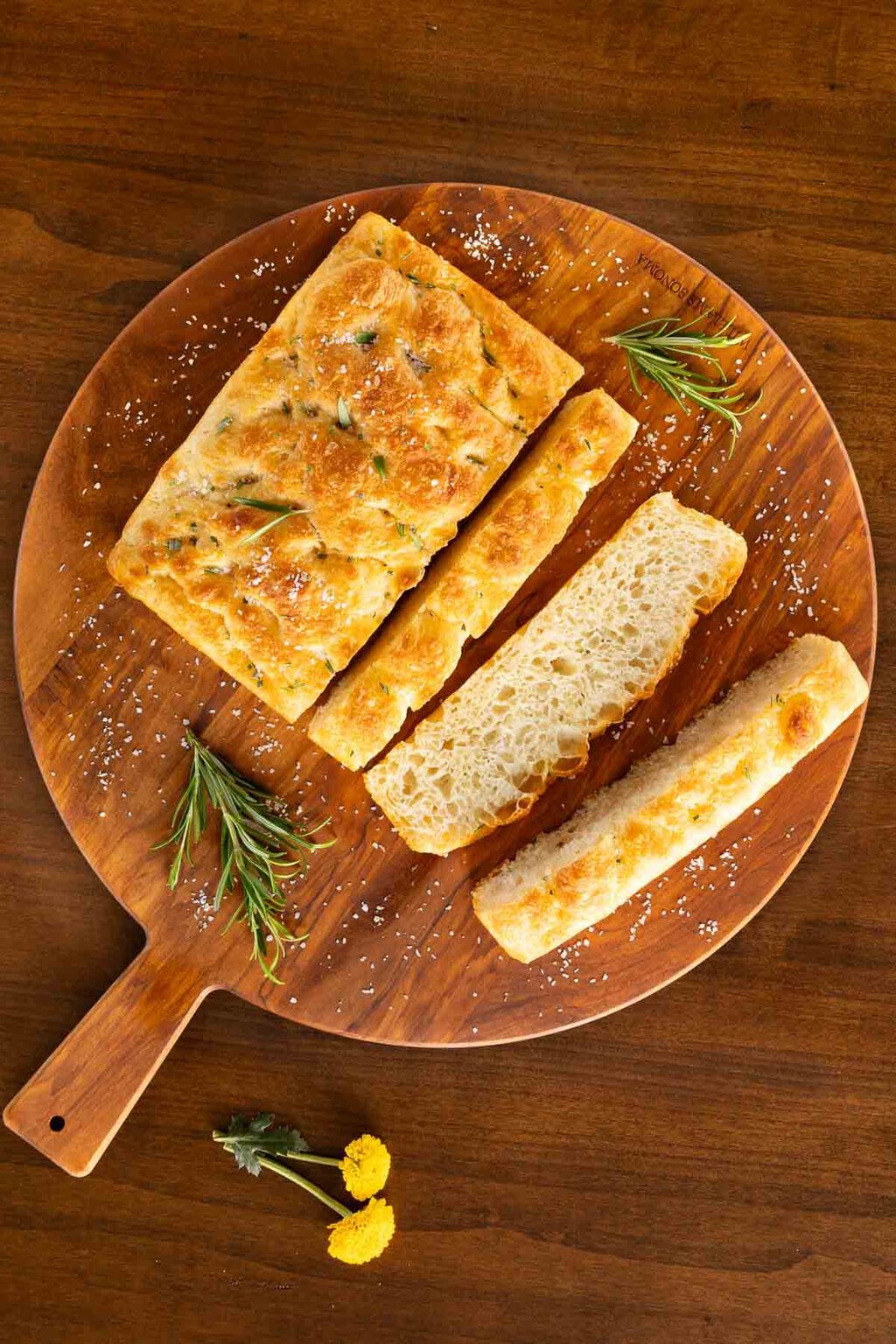
What kind of potatoes should I use for this recipe?
You could cook and mash potatoes or even use leftover mashed potatoes but we're making things super easy here by using potato flakes.
What kind of potato flakes? I like to look for potato flakes with only one item listed in the ingredient list: potatoes. That way, I know I'm not adding unhealthy additives to my focaccia.
This is not a sponsored post but I like Bob's Red Mill Potato Flakes as there are no "extra" ingredients besides potatoes. You can find Bob's Red Mill at most larger grocery stores and online. If your grocery doesn't have Bob's Red Mill, just look for a product with just "potatoes" or "dehydrated potatoes" in the ingredient list.
If you happen to have leftover mashed potatoes, that will also work. Just add 1 cup of mashed potatoes to the hot water instead of the potato flakes.
What size pan(s) should I use for this potato focaccia?
You have several options here. I usually use two 8-inch square baking pans for this recipe. You can also use two 9-inch round baking pans and an additional option is one 9x13-inch rectangular cake pan. The 9x13 will make a slightly taller loaf but all of these pans will work well.
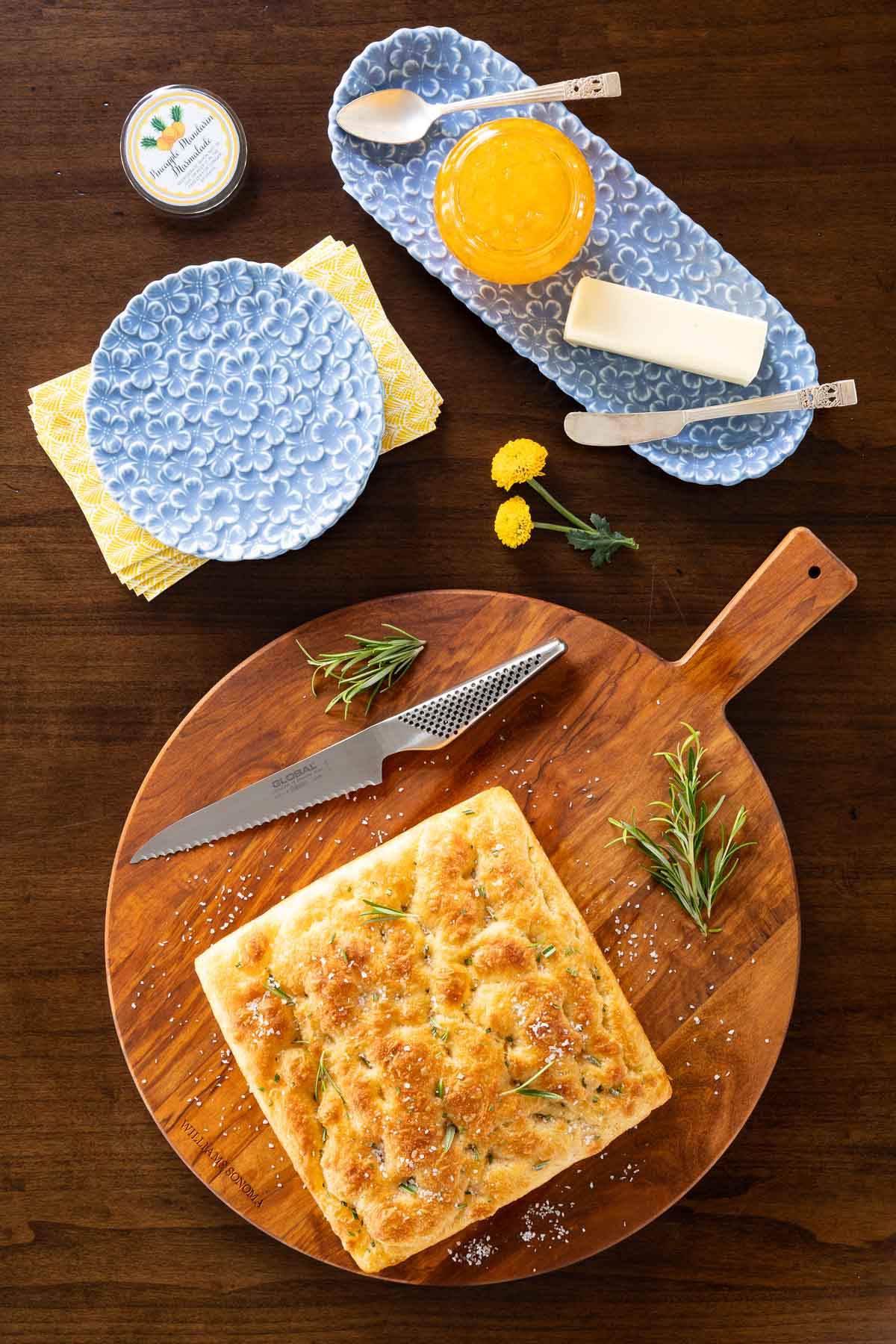
Same-day Focaccia Secrets
Making authentic focaccia generally requires an overnight rise to develop great flavor and those big artisan air bubbles. This Potato Focaccia has the same results in much less time (3-4 hours) and most of it is hands-off!
How does it work? The magic is in the technique called "stretch and fold". It's an easy little trick that doesn't require any expertise. Simply wet your hand or use a silicone spatula to grab the dough from one side of the bowl, stretch it up a bit and over the rest of the dough. Turn the bowl and stretch again. Repeat this until you've worked your way around the bowl. Let the dough rest for 15 minutes, then repeat this rise, stretch and fold two more times.
Here's a picture tutorial of the stretch and fold technique, done with a spatula:
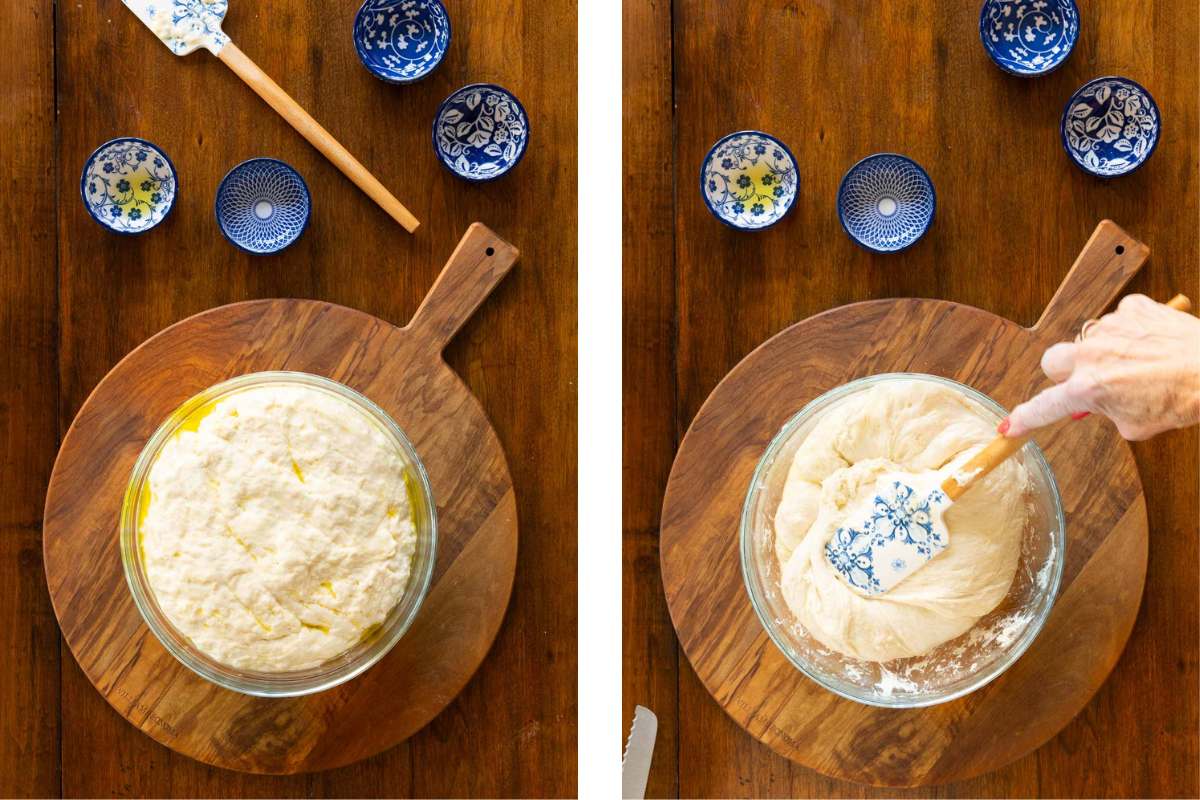
Each "stretch and fold" session takes less than a minute but makes a huge difference in the finished focaccia.
The stretch and fold technique incorporates air into the dough and helps speed up yeast fermentation. That makes the dough rise much faster and helps create those coveted air bubbles. It also improves the gluten structure, making the dough more elastic. This is normally done with lots of kneading or a l-o-n-g, slow rise. The stretch and fold technique eliminates the need to knead (no pun intended), yet produces fabulous results in way less time... yay!
One More Trick
Another little trick I learned from The King Arthur Baking Company helps create this Potato Focaccia's amazingly crisp crust. I was reading through the directions on their newest focaccia recipe and noticed that, after the focaccia is baked, they instruct to remove it from the pan, then return the bread to the oven for 10 minutes. I tried it and, wow, it works like a charm! The bottom and sides of the loaf crisp up beautifully with this final stint in the oven.
How to Serve this Potato Focaccia
This focaccia is fabulous right from the oven! We also love to serve it with salads, soups and in the bread basket with main entrees. It's lovely with softened butter or small bowls of olive oil. You can add a drizzle of balsamic vinegar to the olive oil and/or a sprinkle of fresh or dry herbs.
I often slice it into 1-1½-inch strips before freezing it in a ziplock bag. I just pull as many strips out of the freezer as a I need, drizzle each one with a little olive oil then pop them in the oven or air fryer (375˚F) until crisp and golden. So delicious!
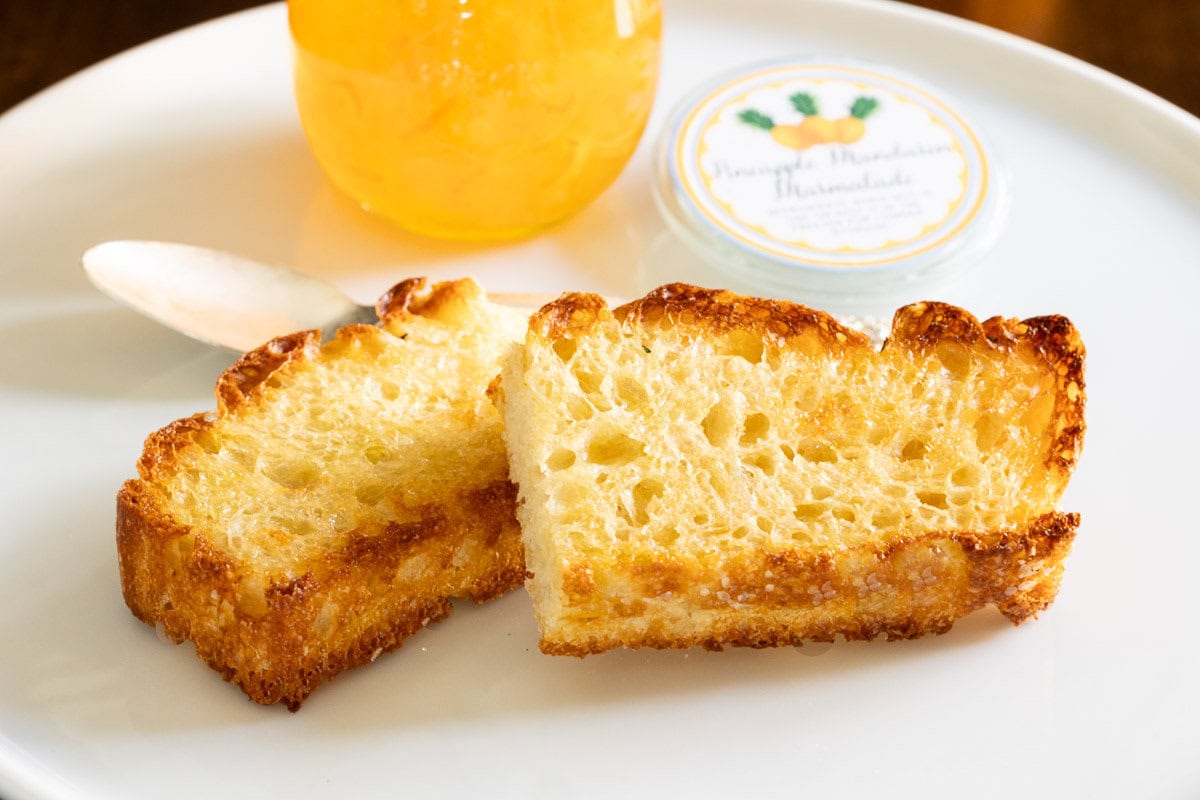
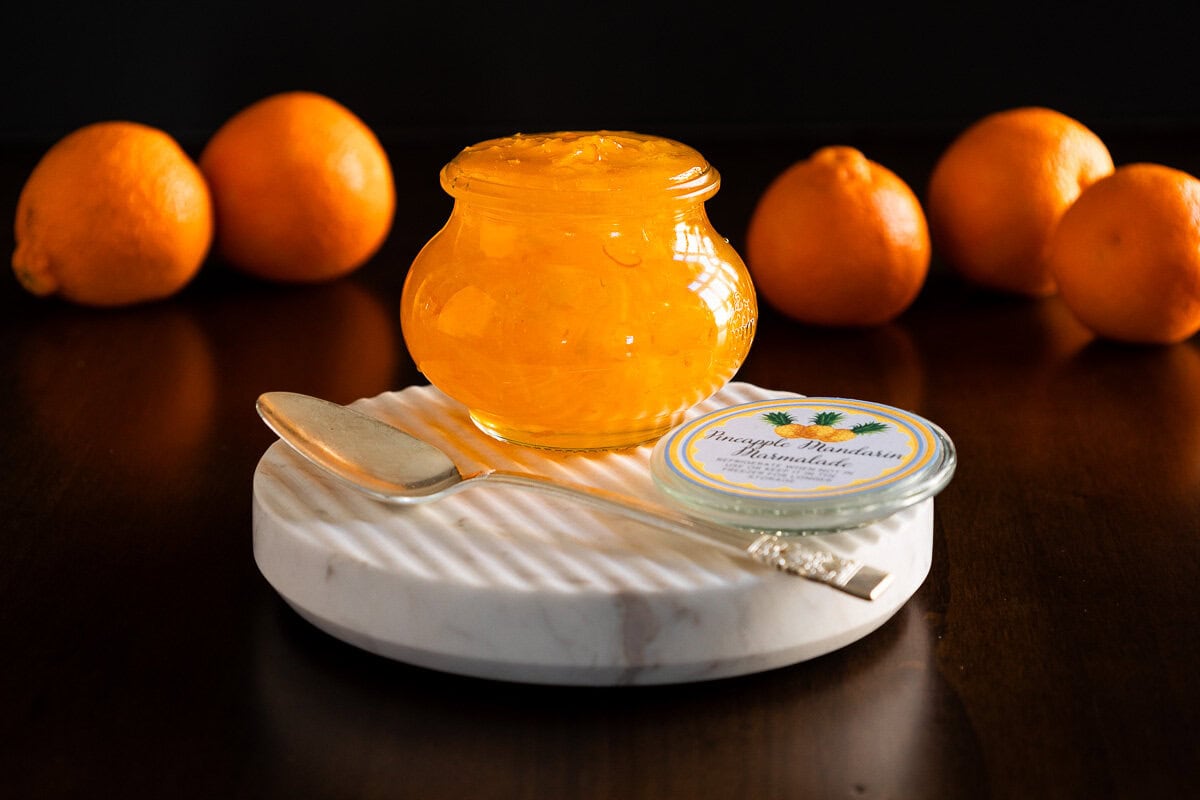
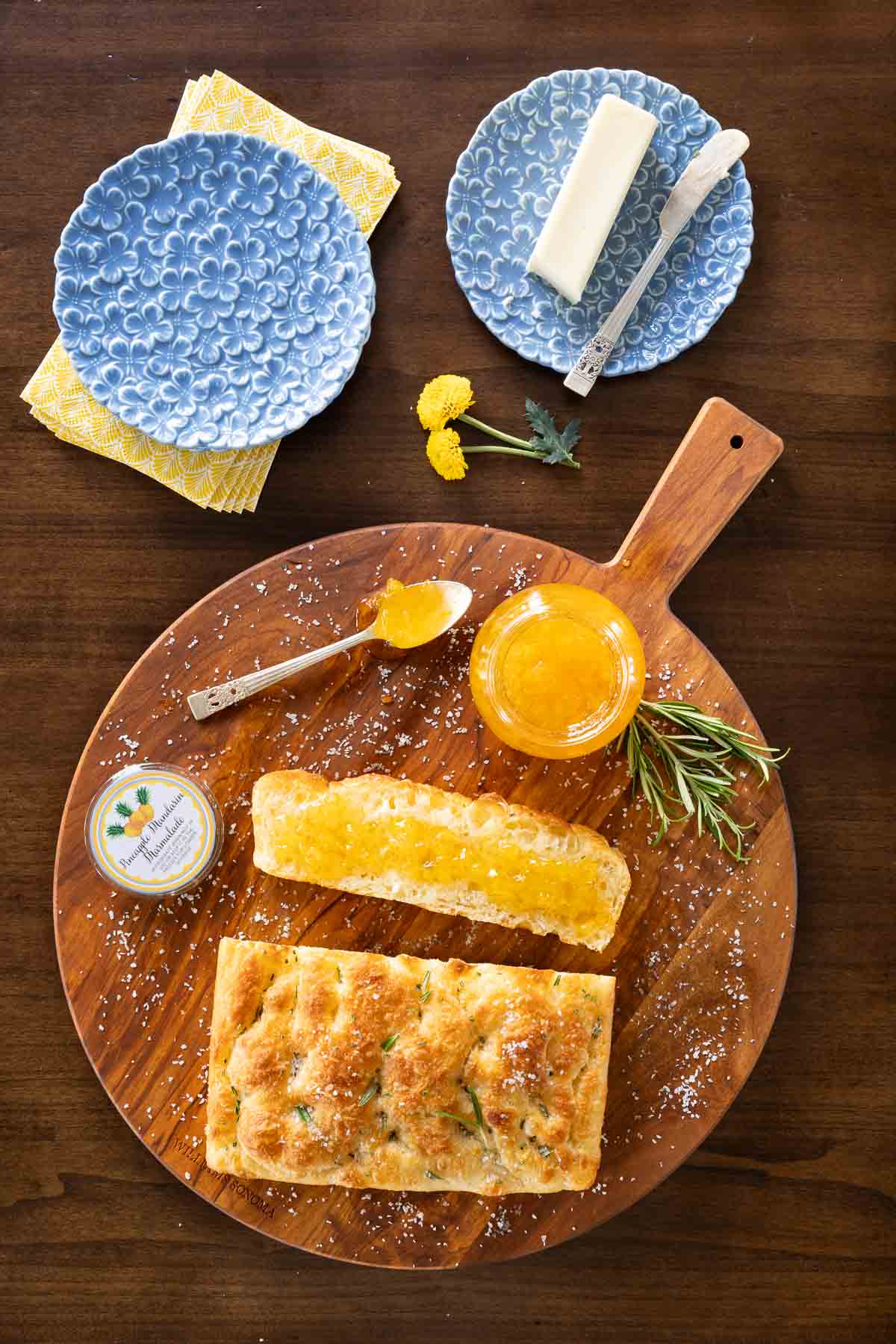
This crisp golden toast is wonderful drizzled with honey or spread with a spoonful of jam. Our favorite jam right now is the Pineapple Mandarin Marmalade pictured in this post with the focaccia and below (recipe coming up next!).
Oh, and one last idea: slice the focaccia in half, horizontally, then drizzle one half (or both) with a little olive oil. Place it in the oven or air fryer to crisp up a bit then top with your favorite pizza sauce (this is ours) and toppings. This is wonderful when it's 6 pm and you have no idea what's for dinner. Don't ask me how I know about this.
If there's a loaf of this Potato Focaccia stashed in the freezer, you're not far away from a delicious meal! Add a simple green salad and you've got a little feast!
Make it!
So put "potato flakes" on your shopping list and have a go at it! This Potato Focaccia is the perfect recipe to make when you're going to be hanging around the house. It won't take much hands-on time and pretty much makes itself, other than the few minutes it takes to mix up the dough and the stretch and fold sessions.
If you don't believe me, check out the video we made to show you just how easy it is:
When the amazing aromas come wafting out of the oven, you can pretend that you're the proprietor of a little focacceria or panificio (bake shop) on the coast of Southern Italy. Saluti!
Cafe Tips for making this Potato Focaccia (Focaccia Pugliese)
- It's important to find a nice warm place for your dough to rise. That can be difficult, especially during the colder months of the year. Here are some ideas for creating an ideal rising climate:
- Bring a cup of water to a boil inside your microwave. Place the bowl of dough in the steamy microwave covered with a clean kitchen towel.
- Another microwave trick - place the bowl of dough in the microwave and cover it with a clean kitchen towel. Let one end of the towel hang out of the door. Close the door with the towel across the opening. This will cause the light to remain on in the microwave creating a nice warm environment.
- Heat the oven at 350˚F for 1-2 minutes then turn it off. It should be slightly warm but NOT hot. Turn the light on in the oven to maintain a warm, cozy rising spot.
- If the top of your refrigerator is clear, this is also a nice warm spot for bread dough.
- Turn your dryer on for 5 minutes then turn it off and let the dough rise inside.
- I like to use bread flour for this focaccia if I have it - but it isn't necessary. Bread flour is higher in protein and creates more stability, form, and rise in the dough, allowing it to lift and hold shape. I have used both bread flour and all-purpose flour with good results.
- Wondering about the instant potato flakes or subbing mashed potatoes for the flakes? See the paragraph above, titled, "What kind of potatoes should I use for this recipe?".
- While we're talking about mixing the dough, make sure all of the flour is well incorporated and there are not any little pockets of dry flour. I always stir it up until I think it's well mixed and then stir a little more.
- Be sure to grease your pan (with butter) and line it with parchment paper. This recipe calls for Instant Yeast which is also called Rapid Rise Yeast. It's quite magical as it doesn't require proofing like regular yeast does. Don't try to use regular yeast in this recipe. You can find Instant or Rapid Rise Yeast at most grocery stores, right next to the regular yeast. You can also buy it in bulk and store it indefinitely in the freezer. It's infinitely cheaper buying yeast in bulk vs purchasing it in the little packets.
- Don't be shy when you "dimple" the dough, just before baking. You want to poke your fingers in all the way to the bottom of the pan and actually make little holes with your fingers. This will ensure nice deep dimples that won't disappear in the oven.
Thought for the day:
For You, O Lord, are good and forgiving,
abounding in steadfast love to all who call upon you.
Psalm 86:5
What we're listening to for inspiration:

If you enjoy this recipe, please come back and leave a star rating and review! It's so helpful to other readers to hear your results, adaptations and ideas for variations.
Scroll Down for the Recipe - or Save It to Your Inbox
We'll email you the recipe so it's easy to save, print, or share.
Potato Focaccia (Focaccia Pugliese) - No Knead, No Mixer!
Ingredients
For the dough:
- 2⅔ cups hot tap water, maybe more
- ⅔ cup instant potato flakes, I like Bob's Red Mill brand
- 3 tablespoons honey
- 2 tablespoons extra virgin olive oil, divided
- 4¼ cups bread flour, all-purpose flour can also be used
- 2 ¼ teaspoons instant yeast
- 2 teaspoons kosher salt
For the pans:
- 2 teaspoons soft butter
- 2 tablespoons extra virgin olive oil
Before baking:
- 2 tablespoons extra virgin olive oil
- flaky or coarse sea salt or kosher salt, if desired for topping
Instructions
For the dough:
- Combine the hot tap water, potato flakes (instant potatoes), honey and 1 tablespoon of oil in a medium-size bowl. Stir for 15-20 seconds until well combined. (If you measure the oil before the honey, the honey will easily slide out of your tablespoon.) Allow this mixture to sit while you prep the other ingredients.
- Combine the flour, yeast and salt in a large bowl (at least 10 cup size). Stir well with a sturdy spatula or wooden spoon to combine.
- Add approximately half of the potato water mixture (no need to measure). Stir well to incorporate the liquid. The mixture will be shaggy and dry at this point. Add the remaining potato water and stir again until the water is well incorporated and there is no dry flour.
- Flour and potato flakes can vary in their level of "thirstiness". If there are still pockets of flour after mixing well, drizzle in a little more water, one tablespoon at a time until you have a thick, shaggy, wet dough with no pockets of dry flour.
- Drizzle the other tablespoon of oil over the dough and stir just until it's incorporated but there's still a thin layer of oil coating the dough.
For rising and stretch and fold technique:
- Cover tightly with plastic wrap and place the bowl in a warm, cozy place (see the post for suggestions) for 15 minutes.
- After 15 minutes, remove the cover and, using a spatula or a wet hand, pick up one side of the dough, stretch it up, fold it over the dough and tuck in down on the other side. Turn the bowl one-quarter turn and repeat the stretch and fold. Repeat the stretch and fold 3-4 more times, turning the bowl one-quarter each time. If your fingers get sticky, re-wet them between stretch and folds.
- Cover the bowl and let the dough rise again in a warm place for 15 minutes, followed by another series of stretch and folds. Repeat this 15-minute rise followed by a stretch and fold one more time. (You will have had 3 15-minute rises, each followed by a series of stretches and folds.)
- After the 3rd stretch and fold, cover the dough and let it rise for 30 minutes or until doubled in size. (The time will vary depending on the yeast and temperature of the area where the dough is rising.)
For the pans:
- During the 30-minute rise, use your fingers or a piece of paper toweling to rub 1 teaspoon of butter over the bottom and up the sides of 2 8-inch square pans OR 2 9-inch round pans. (You can also use a 9x13-inch cake pan - use all of the butter to grease the pan.)
- Line each pan with a square, circle or rectangle of parchment paper, depending on what type of pan you're using. Drizzle one tablespoon of olive oil over the bottom of each pan (two, if you're using a 9x13-inch pan). Rub the oil with your hand to coat the bottom and sides of the pan. Set aside.
To continue:
- When the dough has doubled in size, divide it into 2 portions with a silicone spatula or an oiled hand. Place each portion in one of the prepared pans. Flip the dough over to coat it with oil and spread it out with oiled fingers in the pan. If it doesn't cover the entire pan at this point, no worries. Spread it out as much as you can to cover the bottom of the pan.
- Set the pans back in your warm place for 30 minutes or until doubled in size.
- Generously oil your fingers (both hands) and start at the center of the dough, dimpling and stretching it towards one end of the pan. At this point, you're trying to evenly fill the pan to the edge and into the corners. Be gentle (to keep from deflating the dough too much), but reach down to the bottom of the pan as you dimple. Return to the center and dimple and stretch the dough out towards the opposite edge. If the dough seems resistant at any point, let it rest for a few minutes before proceeding.
- Once you've completed the dimpling, set the pan aside to rest (again in your warm area) while you preheat the oven.
To finish and bake:
- With one rack in the center position, preheat the oven to 450˚F.
- Once the oven reaches 450, drizzle the dimpled dough with 1 tablespoon extra virgin olive oil. Finish off with a light sprinkle of flaky sea salt (I love Maldon sea salt) or kosher salt. Sometimes I also use a teaspoon of finely chopped fresh rosemary.
- Bake on the center rack in the oven for 14-18 minutes or until nicely golden brown. Turn the oven off and remove the focaccia to a wire cooling rack.
- If the bread seems to be stuck to the sides of the pan, run a small thin-bladed knife around the edges of the pan, putting pressure towards the pan, not the bread.
- Remove the focaccia from the pan with a metal spatula. Cool on a wire cooking rack for 10 minutes, then return to the oven (turned off) for 10 minutes to crisp the exterior crust.
- Let the focaccia cool for 10-15 minutes before slicing. Enjoy the bread warm or allow it to cool completely before storing it.
To serve:
- I like to warm the bread again before serving. I preheat the oven to 325 and put the loaf right on the center rack for 10 minutes. The crust will get nice and crisp again.
To store:
- Store in an airtight zippered bag.
- You can also freeze this bread.. I like to slice it in 1-1½-inch wide strips before freezing so I can pull out as many pieces as I want without thawing the whole thing.
- I drizzle each side of the frozen slices with a little olive oil, then toast until golden in the air fryer or oven. So delicious with soups, salads, and entrés!
Notes
Nutrition
Shop Our Café Loves
We’ve gathered our favorite kitchen tools, tableware, and entertaining treasures in one place, the Café Loves store. It’s a wonderful spot to find something special for yourself or the cooks and hosts you love!




Love this recipe - our go to focaccia bread recipe. Are you able to freeze the dough before cooking (so I can cook fresh for guests at the time)? And at what stage of the process?
Hi Ruth, I haven't tried freezing the dough but I have had succes refrigerating it and then baking the next day.
I am going over the recipe,
I am assuming I can double the recipe using a 13 x 18 x 2 pan.
27 grams of yeast seems like an awful lot.
Hi John, yes, that will work to double the recipe in your pan. Thanks for the heads up regarding the yeast. My recipe plugin does the metric conversion and, sometimes, it can be off. I have manually converted and changed that measurement. It should be 7g of instant yeast for one recipe of potato focaccia. ENJOY!
I have had focaccia made with potatoes and dimpled with tomatoes. It was delicious. Does this dough take tomatoes in the dough before baking?
Hi Terry, that would work! I use tomatoes in this focaccia and it's so delicious: https://thecafesucrefarine.com/milk-streets-tomato-olive-focaccia-the-ridiculously-easy-way/
Could you please confirm the amount of water required. I weighed 531 g of bread flour and used 2 2/3 cups of water. My dough turned into soup. I made it twice, once using potato flakes and one with mashed potato.
I noticed in the video that at the last step , you added olive oil and additional amount of flour? Thank you.
Hi Marina, this is a very wet dough but it should not be soupy. The ingredient amounts are correct, however, every flour is a little different in its "thirties", so if your dough is soupy, add a bit more flour.
This is by far the best focaccia I have ever made. So easy and so good. Make it at least twice a week because it goes so fast. A keeper!!!
Awesome! Thank you for the review, Liz!
Love to try. Can I use gluten free flour instead of the bread flour?
Hi Barbara, I have not tested this recipe with GF flour. To ensure success, it would be better to use a focaccia recipe that has been designed for GF flour.
I just pulled the focaccia out of the oven. It looks great but will put it back in after the 10 minutes to crisp. After the 3rd folding and set to rise for 30 minutes, should it be covered? I covered it for all rising times. Is this correct?
Yes, that is correct, Polly! Hope you enjoy it!
As someone who has baked a lot of rolls with potato dough, I can attest that even frozen leftover mashed potatoes work well.
Thanks, BTP!
Thanks to a now old, Chatelaine Cookbook, I have recipe for hot cross buns made with mashed potatoes. Well loved. So thinking, I have box of potato starch; used it once for thickening, & loved the result—could one use a smallish amount in biscuits etc—with a nice result. Potato starch, potato flour?—will look up if there is a difference
So many great tips! Yay...new marmalade up next (I already would like the labels!). Focaccia has so many uses and I suspect this will be my go-to recipe. Thanks Chris.
Thanks, Vivian! Enjoy!
Hello, I’m wanting to use leftover mashed potatoes in this recipe. What is the ratio of mashed potatoes to potato flakes?
Thank you!
I apologize if this is answered in the article and I missed it 😊
Hi Sabra, use 1 cup of prepared mashed potatoes.
Thank you for this substitution.
Can't wait to try this recipe. Looks great as I am sure it will be. I have never been disappointed in any of your recipes. In the winter I use a seed warming mat to help dough to rise. I know everyone doesn't have one but it works very well.
Thank you, Jean! Enjoy!
Well, I went back to read ALL the notes and found my answer, actually in two places, of course. Excuse my enthisiasm.
Thanks, Diane! Enjoy!
Great Recipe! My favorite cinnamon roll recipe uses mashed white potatoes and it too is amazing. Thanks for posting this.
Thanks, Kathy!
how long do you bake the 13x9 focaccia. also, can i use olive oil instead of butter -greasing the pan. if so how much oil
Sounds wonderful and I will try it but question: have you tried using cooked potato in lieu of flakes or must the recipe use flakes for bulk? Thanks!